**[Will's Journal](../index.html)**
(#) **2024/05/24: Vulkan Engine (VKGuide)**
(##) **Vulkan API**
I had found myself delaying my goals for no good reason. After wallowing in my despair for an adequate amount of time, I decided I would finally
begin learning and using Vulkan API as part of my journey to create my own game engine.
Vulkan has a reputation for being both harder and more verbose than OpenGL, so learning it would be a marathon more than a sprint. While knowing OpenGL has helped immensely
in both understanding the structure of a rendering pipeline and coding in c++, it did not equip me for Vulkan.
(###) **Boilerplate**
Vulkan just has so much adjustable values everywhere! Flags, references, libraries; there are a lot of moving parts and it all needs to be constructed before you can even begin
development.
VKGuide is useful, but the guide is still sort of rough around the edges, with a few overlooked points and minor typos. It can be hard to learn if you are unsure of whether the things
you read are true. Still, it is a fantastic resource to get started with Vulkan. It also seems to be more geared towards game engines, which aligns with my goals well.
Some parts of Vulkan still puzzle me, such as synchronization (barriers). But sentiment online seem to suggest that Vulkan's synchronization is a difficult subject to fully grasp. But difficulty
only serves to motivate me. I love the struggle; the fight.
(###) **Compute Shaders**
While maybe not the best idea, I did not mess with compute shaders before I hopped over to Vulkan. Mostly because it seemed a significantly complex subject.
VKGuide starts with compute shaders! I can understand why. From reading the docs, setting up a compute shader pipeline is significantly easier than setting up a rendering pipeline.
_Though the hard part was the setup of the rest of the program, really._ Compute shaders are actually remarkably simple, and to me is just a juiced up CPU that better exposes SIMD architecture to the
developer, simplifying the multithreading aspect of programming. I think it is a fairly neat bit of program, and really, if you boil shaders to their finer bits, they are basically compute shaders
with pre-defined structures to support the rendering pipeline.
(###) **Docs**
I really should have started my Vulkan journey by taking a quick look at the official documentation. Specifically the first few chapters: Introduction, Fundamentals, and Command Buffers; if I had read them
before starting VKGuide, I feel like I would have had an easier time grasping concepts. Certain things that VKGuide describe seem arbitrary, and can be light on further details. It can make it hard
to understand why we do things without a clear image of the bigger picture. The docs shed some light on why certain things are the way that they are.
(###) **Project Structure**
I thought this would be a nice time to demonstrate some MarkDeep magic and below is a graph describing the project's structure so far (Compute shader pipeline).
******************************************************************************************************************************
* .------------------.
* .----------. | Vulkan | .--------------------.
* | SDL | | > Instance | .------------------------------. | Commands |
* | > Init |-------> | > Surface | | Swapchain |--------> | > Command Pool |
* | > Window | | > PhysDevice |------> | > Swapchain Object | | > Command Buffers |
* '----------' | > Device | | > Swapchain Images/Views | '--------------------'
* | > Graphics Queue | | > Draw Image (Render Target) | |
* | > Queue Family | '------------------------------' |
* | | v
* | > VMA |
* '------------------' .-------------------------------.
* | Syncronization Structure |
* | > Fence (Command Buffer) |
* | > Semaphore (Swapchain Image) |
* .--------------------------. | > Semaphore (Render Finish) |
* | Descriptors | '-------------------------------'
* .-------------------. | > Descriptor Pool | |
* | Pipeline | <--------------| > Descriptor Set | <----------------------'
* | > Shaders | | > Populate Set w/ Data |
* | > Pipeline Object | '--------------------------'
* '-------------------'
*
******************************************************************************************************************************
With all the pieces in place at the end of this structure, the draw step can finally be executed.
Apart from the uninteresting synchronization setup, the juice of the program exists here.
```````````````````````````
void VulkanEngine::draw_background(VkCommandBuffer cmd)
{
ComputeEffect& selected = backgroundEffects[currentBackgroundEffect];
// Bind Pipeline
vkCmdBindPipeline(cmd, VK_PIPELINE_BIND_POINT_COMPUTE, selected.pipeline);
// Push Constants
vkCmdPushConstants(cmd, _gradientPipelineLayout, VK_SHADER_STAGE_COMPUTE_BIT, 0, sizeof(ComputePushConstants), &selected._data);
// Bind Descriptor Set
vkCmdBindDescriptorSets(cmd, VK_PIPELINE_BIND_POINT_COMPUTE, _gradientPipelineLayout, 0, 1, &_drawImageDescriptorSet, 0, nullptr);
// Execute at 8x8 thread groups
vkCmdDispatch(cmd, std::ceil(_drawExtent.width / 8.0), std::ceil(_drawExtent.height / 8.0), 1);
}
```````````````````````````
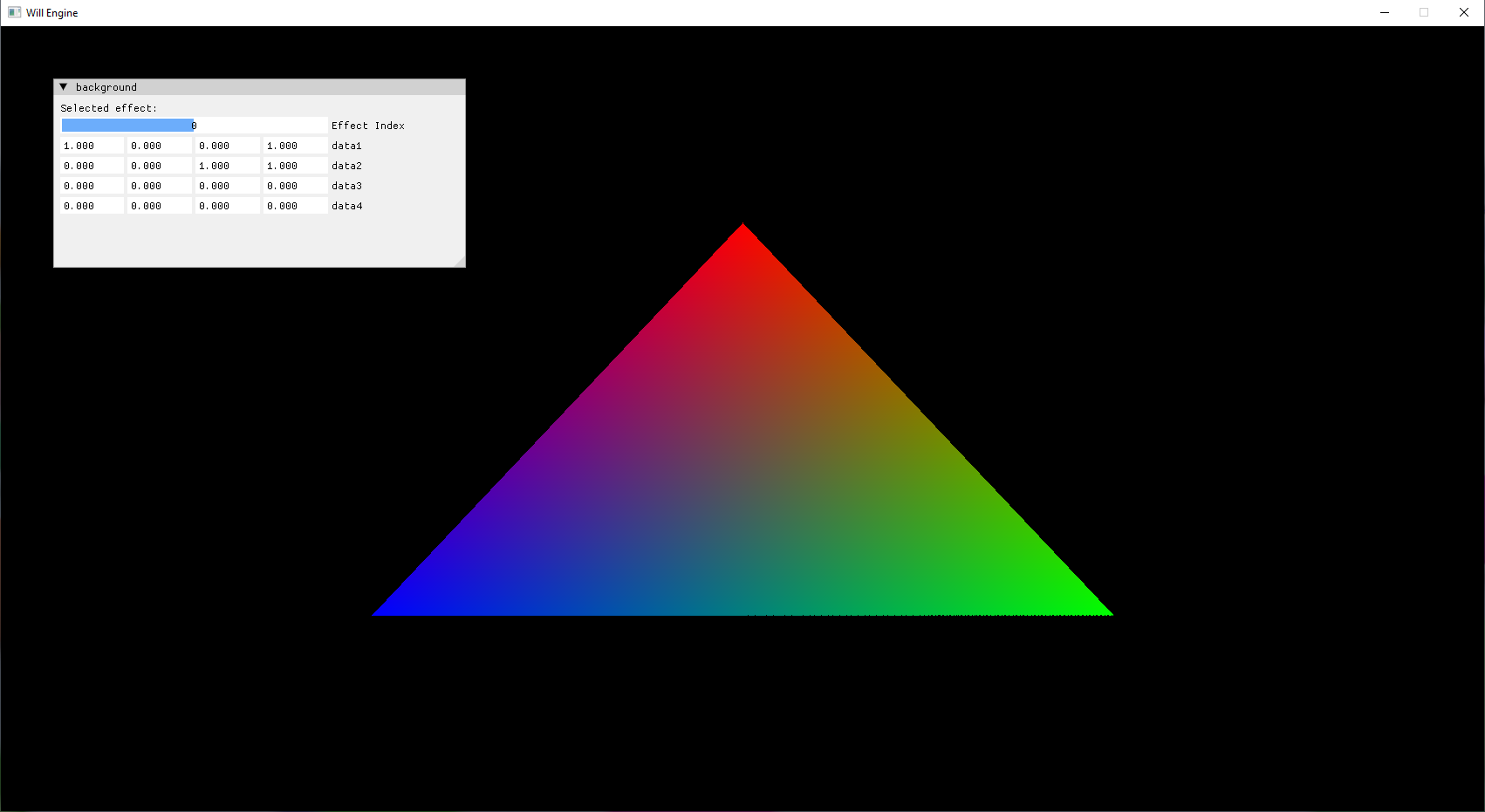
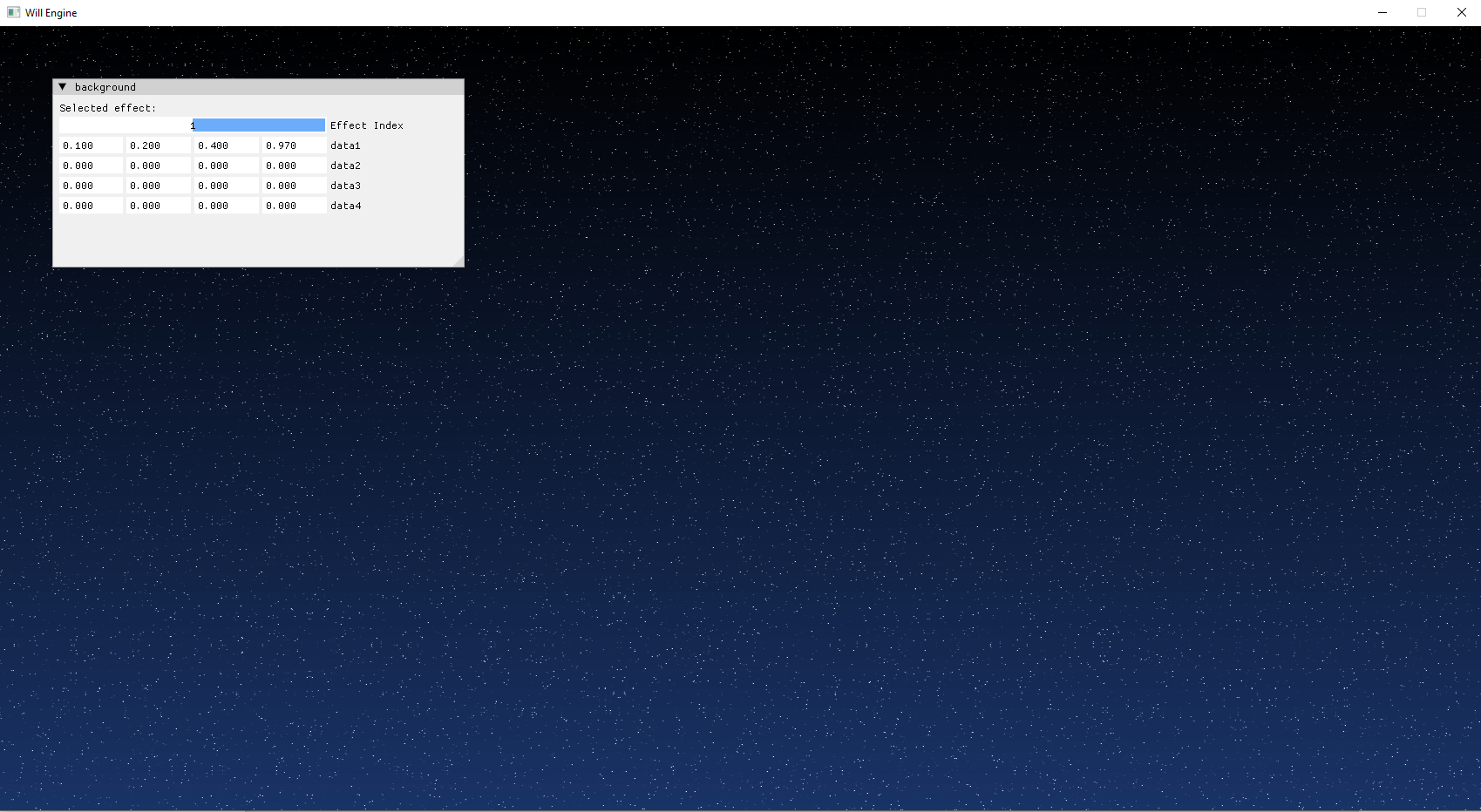
- At this point in the guide, we use 2 compute shaders to show off how easy it is to change between the pipelines (toggled by a slider from imgui)
- Bind the chosen pipeline
- Attach Push Constants
- Bind Descriptor Set
- Dispatch to 64 (8x8) (GPU) threads
Vulkan is great. So much control over the entire rendering structure in the hands of the developer, allowing for better optimization and a closer map between software and hardware.