**[Will's Journal](../index.html)**
(#) **2025/04/04: Serialization, Terrain, and GTAO**
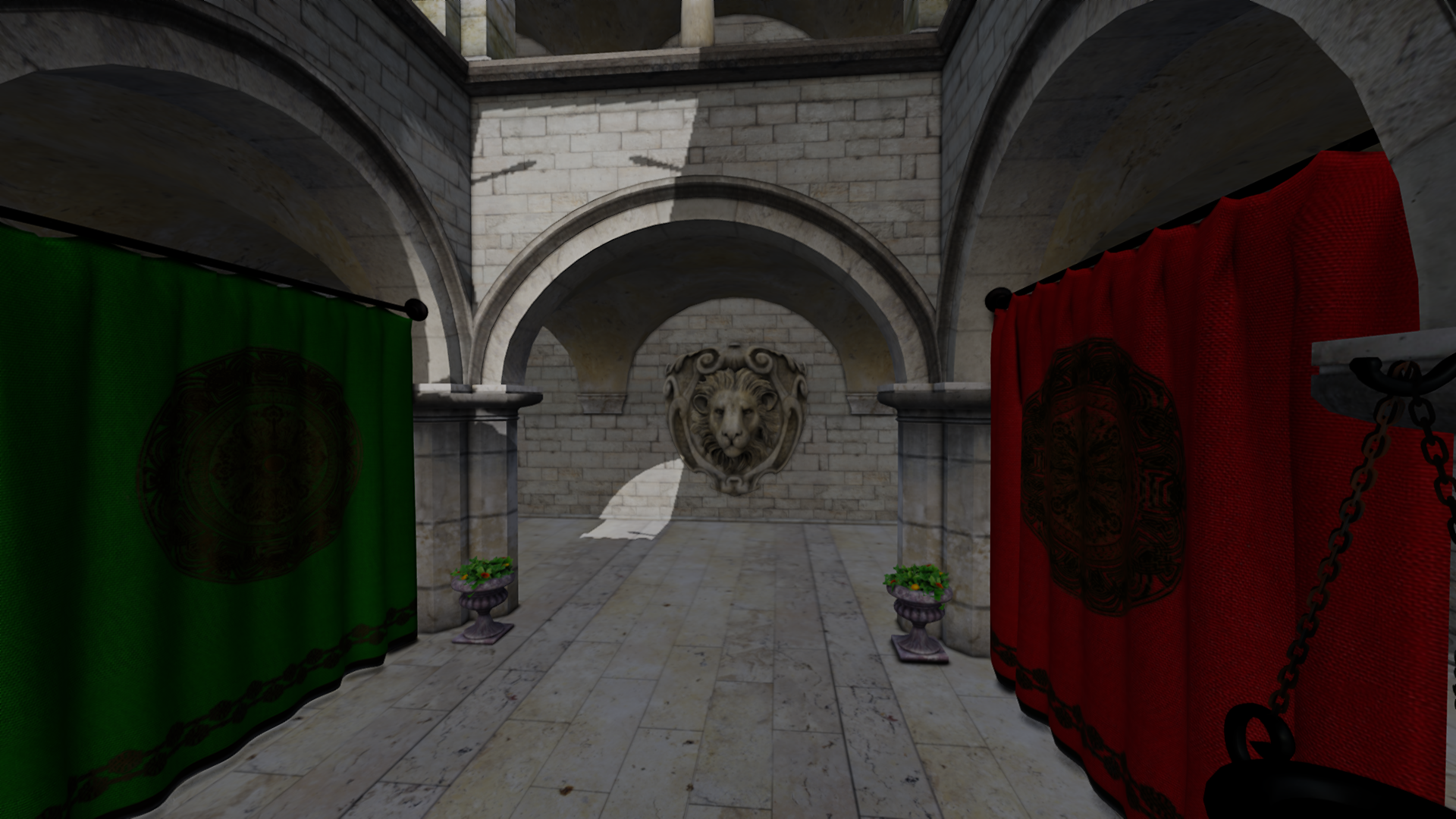
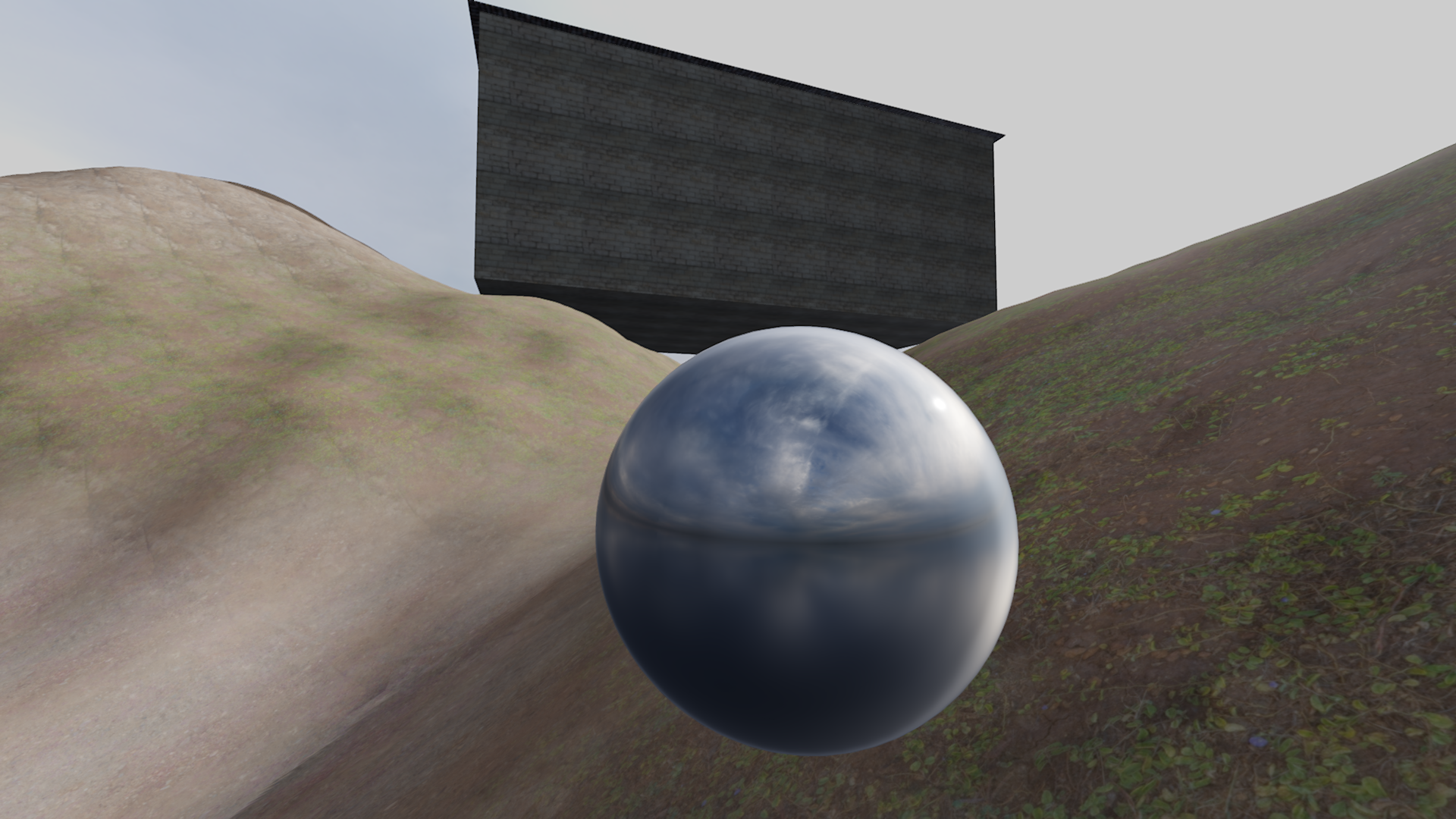
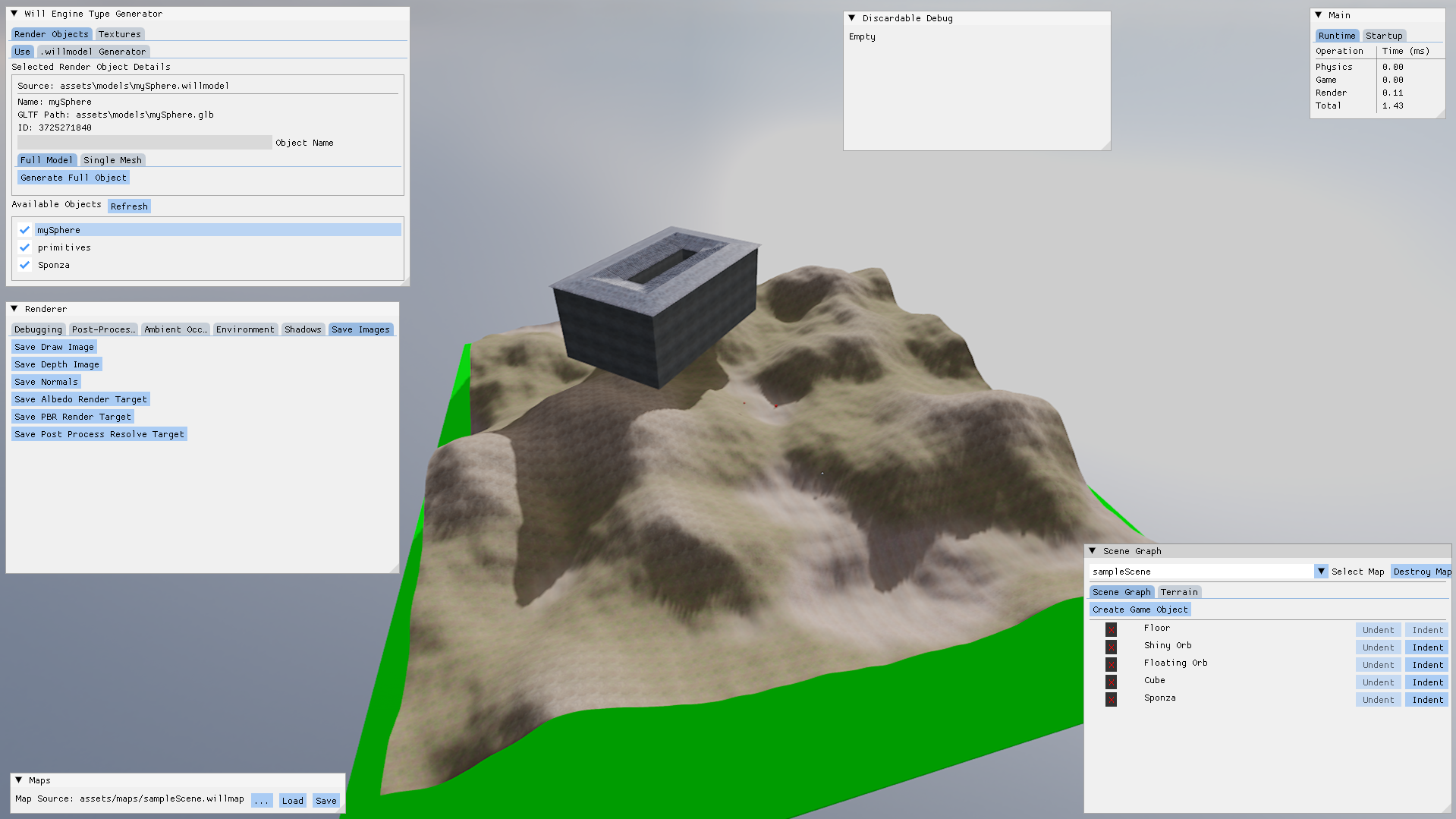
In this quarterly update of my activities, I'd like to share the numerous improvements to my game engine. Frankly a lot has changed since the last journal entry, but I don't really want to talk about every little detail that I worked on. So I'll stick with the 3 main topics in the title. But just to give you a picture of what the engine looks like now, here are some images.
(###) **Serialization**
One of the gripes I had with my engine so far was that any changes made to the game needed to be hard-coded in c++ and recompiled every time which is obviously unsustainable when authoring a scene. Between the compile time, the time to initialize resources, and scene traversal; it became very difficult to make minor visual changes. So I revamped the entire engine to be more modular through the use of interfaces, and improved reusability with new data structures such as Maps.
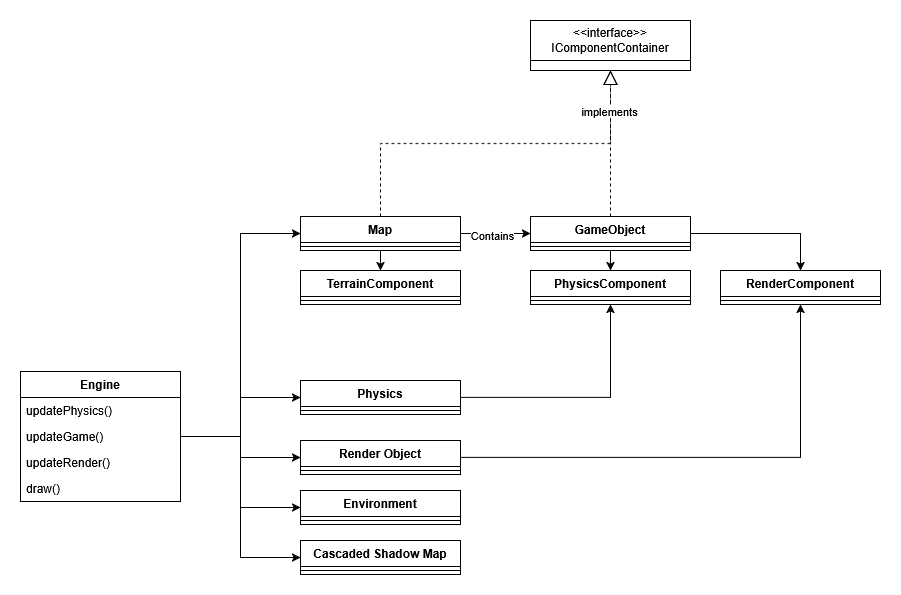
I try my best to separate responsibility between the different parts of the engine to both maintain SOLID principles and prepare for the eventual move way from a single-thread to a multi-thread system. A change that I know will come with a lot of headaches and pain, but one I try to prepare for early on.
The "Map" is the focus of the engine's serialization, as all of a scene's data is neatly packaged into the serialized representation of the map. This includes Metadata, Transforms, Components, and their accompanying properties. It wasn't a small amount of work, but I now have unique files associated with my program: `.willmap`, `.willmodel`, and `.willtexture`; but more on the renderer related types later.
I decided that the data format itself should be in json as I'd like to be able to both read and modify it manually if I ever need to debug things. Certainly less secure, but there isn't really and critical data that needs protecting. Worst case is some data corruption...
The data looks something like
`````
"gameObjects": {
"name": "sampleScene",
"transform": {
"position": {
"x": 0.0,
"y": 0.0,
"z": 0.0
},
"rotation": {
"x": 0.0,
"y": 0.0,
"z": 0.0,
"w": 1.0
},
"scale": {
"x": 1.0,
"y": 1.0,
"z": 1.0
}
},
"components": {
"TerrainComponent": {
"terrain": {
"terrainGenerationProperties": {
"scale": 150.54400634765625,
"persistence": 0.24799999594688416,
"lacunarity": 2.313999891281128,
"octaves": 4,
"offset": {
"x": 0.0,
"y": 0.0
},
"heightScale": 85.78099822998047
},
"terrainSeed": 111219222,
"terrainConfig": {
"uvOffset": {
"x": 0.0,
"y": 0.0
},
"uvScale": {
"x": 50.0,
"y": 50.0
},
"baseColor": {
"x": 0.8725489974021912,
"y": 0.8725489974021912,
"z": 0.8725489974021912,
"w": 1.0
}
},
"terrainProperties": {
"slopeRockThreshold": 0.699999988079071,
"slopeRockBlend": 0.5,
"heightSandThreshold": 0.2800000011920929,
"heightSandBlend": 0.10000000149011612,
"heightGrassThreshold": 0.6499999761581421,
"heightGrassBlend": 0.25,
"minHeight": 5.0,
"maxHeight": 75.0
},
"terrainTextures": [
3813767237,
219859308,
3929634359,
0,
0,
0,
0,
0
]
},
"componentName": "Terrain Component"
}
`````
I mean I wouldn't call this readable... But it is certainly more readable than binary!
I also had the problem of needing to store a persistent copy of the metadata for my render objects. I'm not going to elaborate on what exactly I mean by render objects because it is specific to my engine, but the metadata I needed was simply a name, path, and an ID. The ID needed to be persistent as I generate it using `std::hash` on the path to the .gltf file. Not entirely sure that's the best idea, but `std::hash` doesn't appear to be 100% consistent between hashing on different machines. Additionally the path will likely change between different downloads of the engine, so I can't generate the has at runtime.
Fortunately, because it's just metadata, the contents of the entire model is fairly brief. Here is an example of the metadata for "mysphere.glb".
``````
{
"renderObject": {
"gltfPath": "assets\\models\\mySphere.glb",
"id": 3725271840,
"name": "mySphere"
},
"version": 1
}
``````
But... If I want to import textures from other sources to use in place of the GLTF's texture, I'd need to also have some metadata representation of the textures. So I also made engine representations for those!
``````
{
"texture": {
"gltfPath": "assets\\textures\\brown_mud_leaves_01_diff_2k.jpg",
"id": 3813767237,
"name": "brown_mud_leaves_01_diff_2k",
"textureProperties": {
"mipmapped": true
}
},
"version": 1
}
``````
Serialization does mean that I'd need to create serialization code for all future components and features, but that doesn't seem so bad! I did try to look into runtime reflection to make serialization/deserialization much simpler, but I couldn't find a good one that works with MSVC 17 (VS2022). And even if I did, apparently it adds a significant runtime overhead. If I were to implement it I'd need to create a separate application section just for editor stuff. Seems like more trouble than I'd prefer for my simple game engine.
(###) **Terrain**
Terrain is a big step for me. I actually started work on this project because I wanted to do the whole "Ghost of Tsushima" grass that was all the buzz about 6 months ago (maybe it was longer?). But I knew that I didn't want to half-ass it and sought to make full on game engine/renderer. Step-by-step I developed the engine and now I have reached a point where the terrain is a reasonable addition to the scene to make the engine a little more interesting. Though I have to say I don't really have a good understanding of what makes a good terrain system.
I've used terrain creators in Unity and Unreal, so I know that we want noise generation, a way to hand-author the terrain, and tools/configurations for textures. But to keep things simple for now, I just implemented a perlin noise terrain generator that procedurally textures based on their height in the world and their slope. This certainly could use some work, the blending in particular looks extremely amateur; but I think this is a solid enough start for what I need - which is a terrain base to procedurally generate grass on.
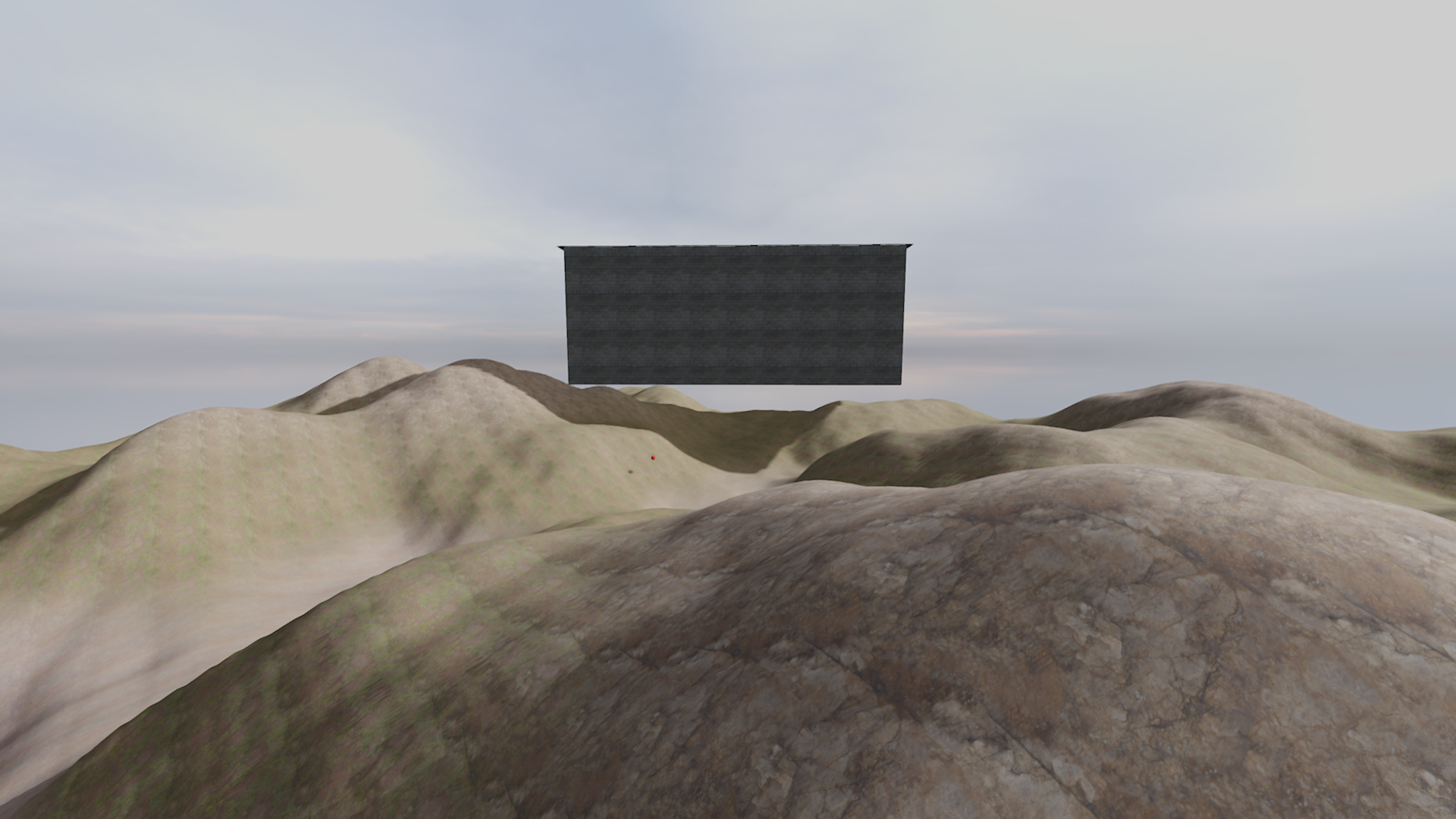
I decided to only allow 1 terrain to exist per map, so if I want to do multiple maps, I'd just make a new map. Not super extendable right now, since the terrain is confined to world origin (and expands from there). Really, a lot could be done to make this more useful, but I'm building to me neeeds, and my need for terrain at the moment is just not very high.
(###) **Ground Truth Ambient Occlusion**
[Ground Truth Ambient Occlusion](https://www.activision.com/cdn/research/PracticalRealtimeStrategiesTRfinal.pdf) is a (relatively) recent implementation of ambient occlusion that is designed to be lightweight and fast on most machines, improving the illusion of full global illumination further. It involves a lot of complicated math to sample the surrounding of a surface to determine how occluded said surface is, reducing the contribution of light towards it if found. Importantly, GTAO is still a screen-space solution and as such is affected by many of the drawbacks associated with screen space solutions.
For the unfamiliar:
- Screen-Edge Artifacts: Where the sampling of the hemisphere cannot account for off-screen geometry, resulting in unoccluded surfaces
- Resolution Dependency: The quality of the SSAO is dependent on the resolution of the image (depth buffer). More pixels means a higher fidelity of nearby surfaces when checking for occluders.
- Performance Considerations: Integration is always difficult because it is (basically) impossible to sample every point along the sampled hemisphere. This problem isn't unique to SSAO.
Some of these issues are improved by using temporal techniques common today. My engine already comes with temporal anti-aliasing, so I don't need to do additional steps to improve temporal consistency.
Implementation-wise, GTAO is quite tricky; involving maths that frankly go right over my head. Fortunately, there is an implementation of it publicly available made by Intel in [XeGTAO](https://github.com/GameTechDev/XeGTAO). The code outlines the process of implementing GTAO very clearly, with pictures and explanations abound. However, the code is for DirectX and uses HLSL... I use Vulkan and GLSL. Not an impossible task, but certainly one that did not entice this programmer.
After a couple weeks of torture, I had finished a GTAO implementation in game engine. Some profiling indicated that the AO takes about 1.0ms when using a render extent of 3840x2160, which is quite impressive! Perhaps it would be higher if my scene had a higher density, but for my simple game engine and sponza, it is quite an impressive result!
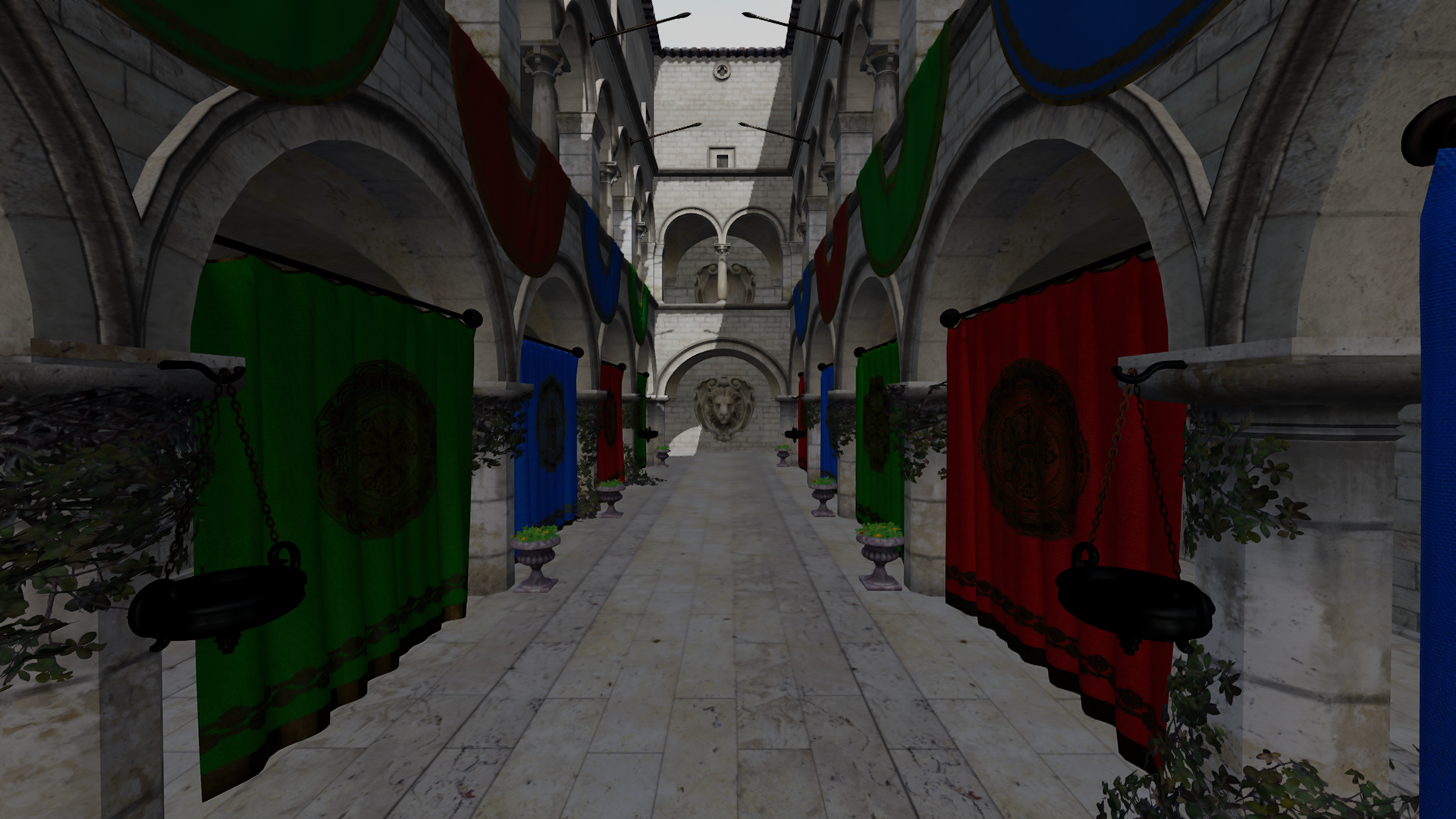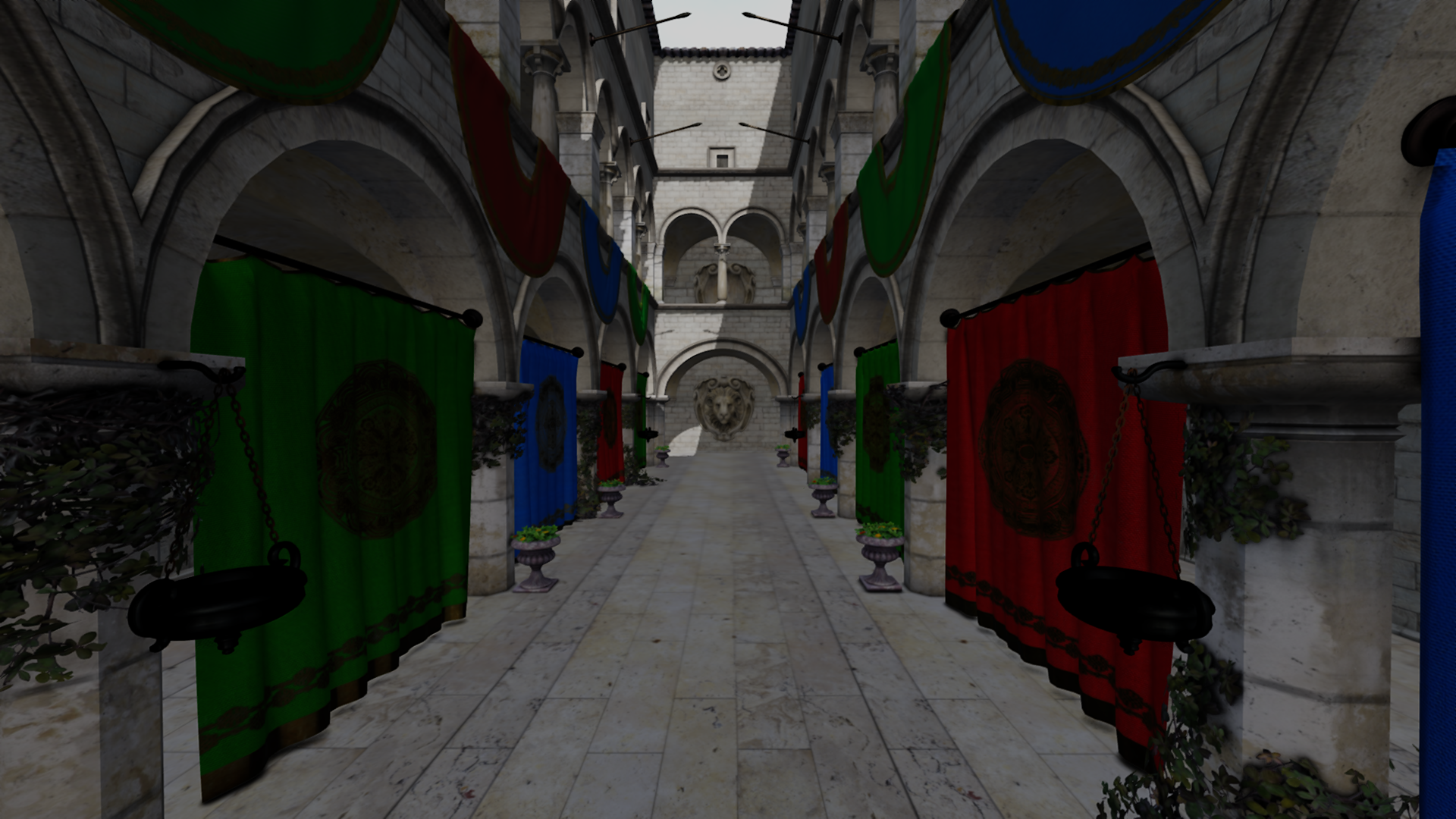
Though, honestly it is quite subtle and unless I was looking for it I'm not sure I would notice. But it isn't a terribly expensive technique, and I still enjoyed the process of implementing a rendering technique in my game engine.
(###) **Post Word**
There are definitely some gripes I have with my engine so far. Shaders are fairly set in stone, and custom shaders are simply not supported in the engine; even for variations on the current deferred MRT pipeline. I would like to do some magic with Non-Photo Realistic (NPR) techniques in the future such as outlines, more solid colors, and shadow effects (e.g. cross-hatching).
Shadows are not in a good state right now, visibly jagged or otherwise affected by significant depth bias issues. I intend on looking into it a bit further but I haven't found it in me to return to shadows for now (figuring out CSMs the first time around was hell).
Terrain is functional but is just kind of ugly to me. I added tessellation recently to improve the fidelity of the normals, but it still looks very plane. I may need to explore some normal, displacement, and parallax occlusion soon to further enhance the quality of the engine.
Thanks for reading if you are reading. As always, I'm always happy to discuss engine/renderer related topics so feel free to contact me through email at twtw40@gmail.com or through discord `williscool`.
(###) **Music**
[Magdalena Bay - Imaginal Disk](https://open.spotify.com/album/4HTy9WFTYooRjE9giTmzAF?si=nij4BfKoQkObaGkauNGAJA)
[Kula Shaker - Natural Magick](https://open.spotify.com/album/4atosprvgEOX83u0RVlQZq?si=IvxVwuEDRMOl59BgaP3vSA)
[Jerry Cantrell - I Want Blood](https://open.spotify.com/album/1clodpcGPsGi0DAwIUHh8L?si=YB1i7Y04QIaSu90AmbdrrQ)
[illuminati hotties - POWER](https://open.spotify.com/album/5YMMVf8CozIqS0IDOoqTAD?si=PFVSwEaDROe3TROtRYXWfQ)